
TL;DR
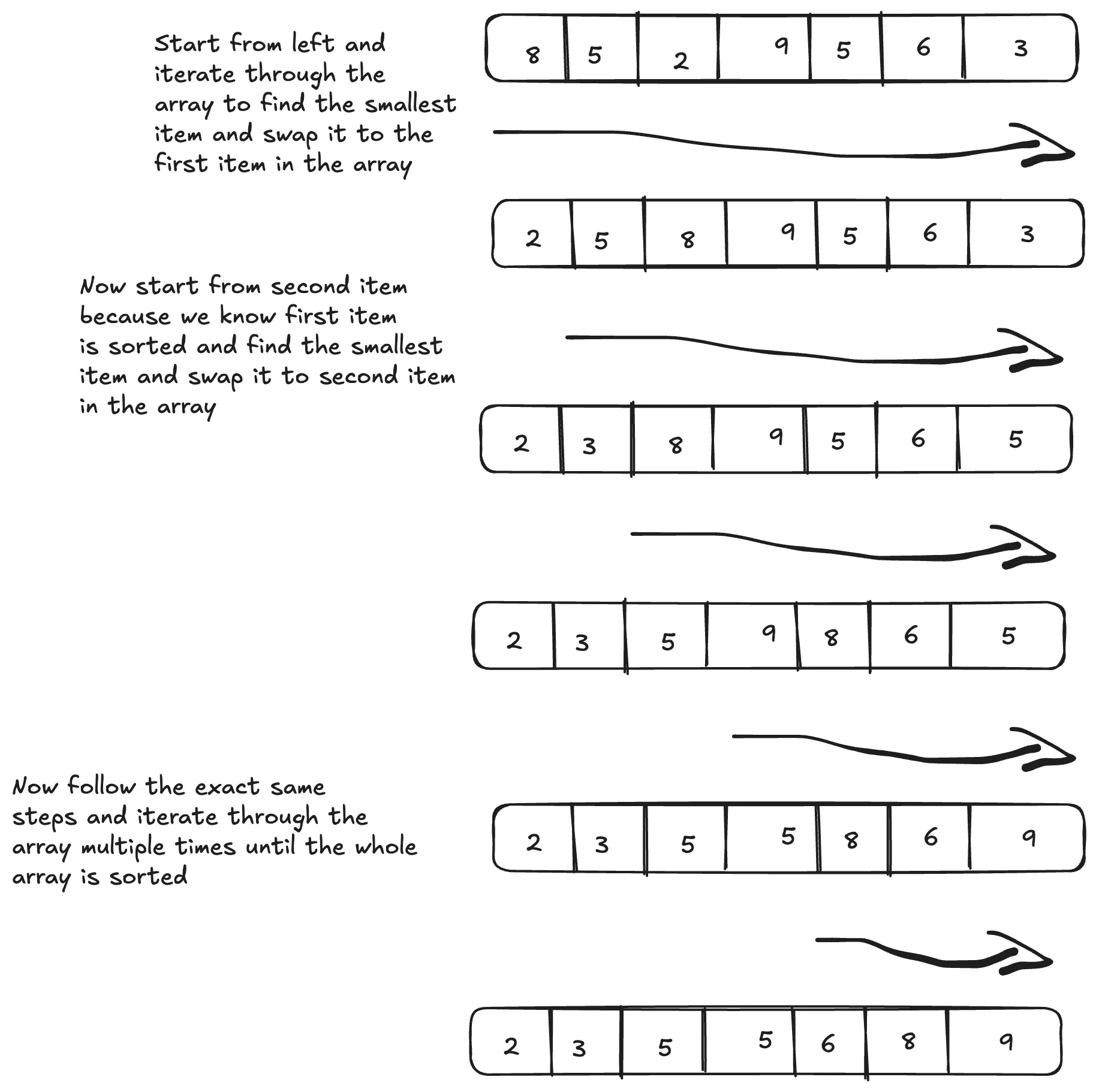
Selection Sort repeatedly selects the smallest (or largest) element from the unsorted portion and swaps it with the first unsorted element. It divides the array into a sorted and an unsorted region and expands the sorted region one element at a time.
1. Algorithm Steps
-
Start from index
i = 0. -
Assume
iis the index of the smallest element. -
Traverse the rest of the array (
j = i+1ton-1) to find the true smallest element. -
Swap the smallest found with the element at index
i. -
Move
ione step to the right and repeat until the array is sorted.
2. Complexity
| Case | Comparisons | Swaps | Notes |
| ------------- | -------------- | --------- | ------------------------------- |
| Worst | O(n²) | O(n) | Every element compared with rest |
| Average | O(n²) | O(n) | No adaptive behavior |
| Best | O(n²) | O(n) | No early exit even if sorted |
| Space | O(1) extra | – | In-place sorting |
| Stability | ❌ Not stable | – | Can disrupt equal elements’ order |
3. Optimizations & Variants
-
Minimum swaps: Only one swap per outer loop, making it better than bubble sort in terms of write operations.
-
Stable Selection Sort: You can make it stable by shifting instead of swapping (less efficient).
-
Reverse Sort: Modify the comparison to
>to sort in descending order.
4. Reference Python Implementation
def selectionSort(array):

for i in range(len(array)):

smallestIdx = i

for j in range(i + 1, len(array)):

if array[j] < array[smallestIdx]:

smallestIdx = j

array[i], array[smallestIdx] = array[smallestIdx], array[i]

return array
5. Practice
Prompt: Write a function that sorts an array of integers using Selection Sort.
Sample Input: [8, 5, 2, 9, 5, 6, 3]
Expected Output: [2, 3, 5, 5, 6, 8, 9]
Optimal Time & Space Complexity:
-
Time: O(n²) always
-
Space: O(1)
6. When (Not) to Use Selection Sort
-
✅ Use when minimizing the number of writes/swaps is critical (e.g., in flash memory).
-
❌ Avoid for large datasets due to quadratic time complexity.
-
❌ Not adaptive — performs equally badly on sorted inputs.
7. Quick Self-Check
-
How does selection sort minimize swaps compared to bubble sort?
-
Why is selection sort not stable by default?
-
Can selection sort be made stable without affecting time complexity?
-
What happens if all elements are already sorted?
8. Further Reading
-
Introduction to Algorithms (CLRS), Section 2.2
Stay sharp — always pick the right tool for the job, just like Selection Sort picks the smallest item each time! 🧠🔍