
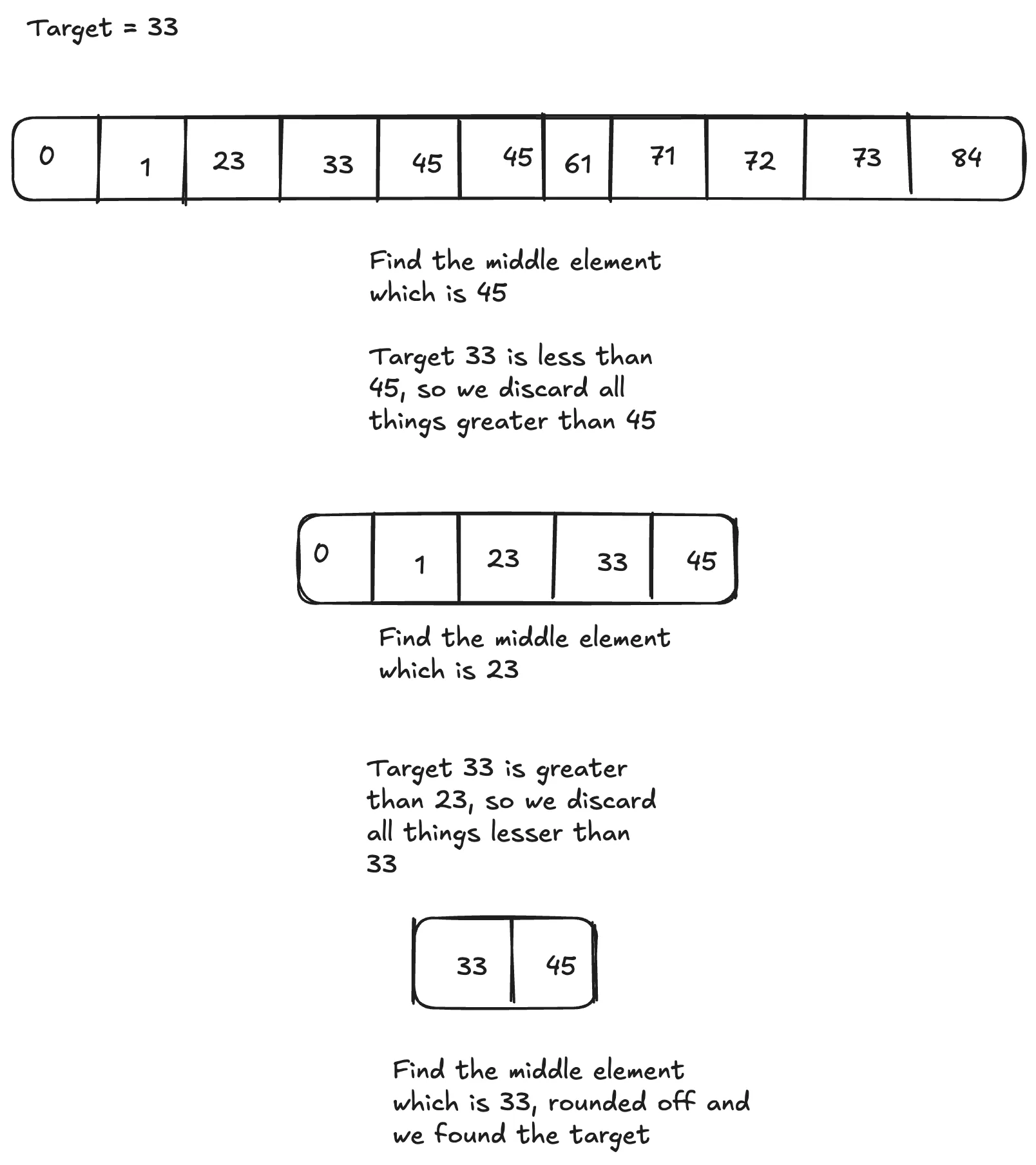
TL;DR Binary Search is a divide-and-conquer algorithm that efficiently finds a target in a sorted array by repeatedly halving the search space. It compares the middle element and eliminates half of the remaining elements each time.
1. Algorithm Steps
-
Start with two pointers:
left = 0,right = len(array) - 1. -
While
left <= right:
-
Compute
middle = (left + right) // 2. -
If
array[middle] == target, returnmiddle. -
If
array[middle] < target, moveleft = middle + 1. -
If
array[middle] > target, moveright = middle - 1.
-
If the target is not found, return
-1.
The recursive version follows the same logic but uses function calls to handle the bounds.
2. Complexity
| Case | Time | Space | Notes |
| ------------- | ----------- | --------- | ------------------------------ |
| Best | O(1) | O(1) | Target is at the middle |
| Average | O(log n)| O(1) (iterative) / O(log n) (recursive) | Dividing array each step |
| Worst | O(log n)| O(1) / O(log n) | Target not found or last match |
| Stability | ❌ Not Stable | – | Doesn’t preserve order |
3. Optimizations & Variants
-
Recursive vs Iterative: Recursive is cleaner, iterative is more memory-efficient.
-
Lower/Upper Bound Search: Modify to find the first or last occurrence.
-
Binary Search on Answer: Used in problems where the search space is implicit (e.g., finding minimum time, max capacity).
-
Rotated Array Search: Requires extra conditions to handle pivoted array.
4. Reference Python Implementation
Recursive version:
def binarySearch(array, target):

return binarySearchHelper(array, target, 0, len(array) - 1)


def binarySearchHelper(array, target, left, right):

if left > right:

return -1

middle = (left + right) // 2

if array[middle] == target:

return middle

elif array[middle] < target:

return binarySearchHelper(array, target, middle + 1, right)

else:

return binarySearchHelper(array, target, left, middle - 1)
5. Practice
Prompt: Implement binary search on a sorted list of integers.
Sample Input:
array = [0, 1, 21, 33, 45, 45, 61, 71, 72, 73]

target = 33
Expected Output: 3
Time & Space Complexity:
-
Time: O(log n)
-
Space: O(1) for iterative, O(log n) for recursive
6. When (Not) to Use Binary Search
-
✅ Use when array is sorted.
-
✅ Use when you need to quickly locate elements in large datasets.
-
❌ Don’t use on unsorted arrays or linked lists (random access is required).
7. Quick Self-Check
-
What is the time complexity of Binary Search?
-
Can Binary Search work on unsorted data?
-
What’s the difference in space complexity between recursive and iterative implementations?
-
What happens if the element appears multiple times?
8. Further Reading
-
Introduction to Algorithms (CLRS), Chapter on Searching
Stay sharp, divide smart! 🧠🔍